
July 14, 2026
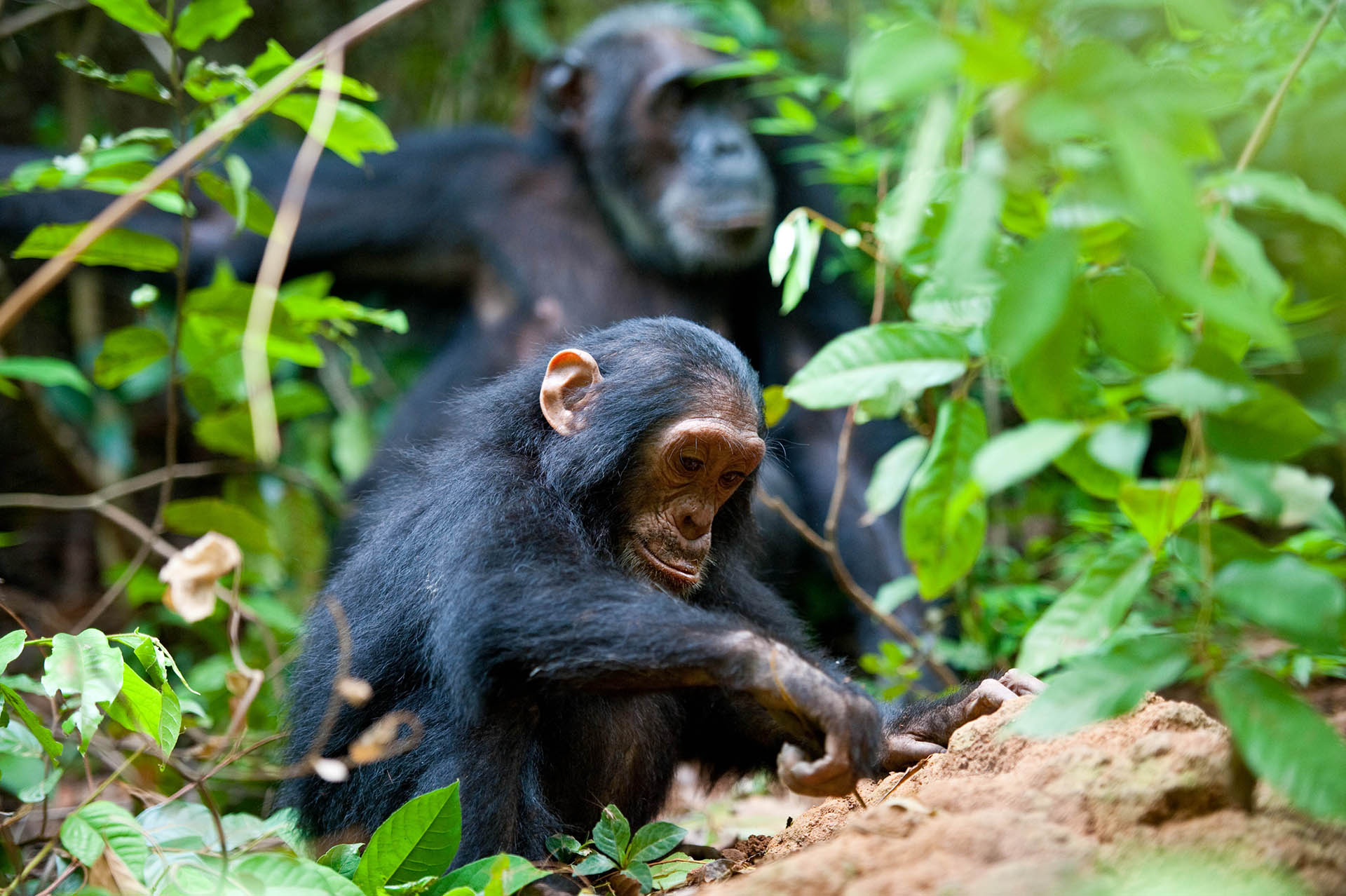
July 14 marks World Chimpanzee Day, commemorating the day a young Jane Goodall first arrived in Gombe, Tanzania, in 1960. More than 65 years later, her groundbreaking discoveries continue to transform our understanding of chimpanzees and inspire the Jane Goodall Institute’s ongoing commitment to protecting them and the habitats they call home.
When Jane Goodall began studying the wild chimpanzees of Gombe, she noticed that chimpanzees learn from one and other. While observing the chimpanzees of Gombe, she watched them carefully select and modify grass stems and sticks to “fish” for termites—a behavior that was not instinctive but learned.
Reflecting on her observations, she wrote:
“It is a social tradition which represents the emergence of a primitive culture—if culture consists of behaviour patterns transmitted by imitation or tuition.”
At the time, the idea that chimpanzees possess culture was controversial – and rejected by large parts of the scientific community. Many scientists believed that animal behavior was either genetically determined or learned individually though trial and error. Jane’s observations challenged that assumption, opening the door to decades of research that would reveal just how complex chimpanzee societies are.
A Rich Diversity of Traditions
As researchers expanded their studies, observing wild chimpanzees at additional field sites across Africa, it became possible to compare behaviors from one group to another. This revealed that chimpanzees use a remarkable variety of tools, not only for termite fishing but in many other contexts as well.
Chimpanzees use stones to crack open hard-shelled nuts, fashion leaf sponges to collect drinking water, and even use sharpened sticks as spears to hunt other animals, among many other examples. In some regions, chimpanzees use a sequence of two tools for termite fishing. First, they break open the hard outer surface of a termite mound with a sturdy stick. They then insert a flexible rod with a brush-like tip into the mound’s winding tunnels, where aggressive termites latch onto the fibres – only to be pulled out and eaten with gusto.
Learning Through Observation
Chimpanzees are highly social animals and attentive observers. Young chimpanzees spend years watching their mothers and other members of their community, gradually mastering the skills needed to survive.
Research has shown that acquiring complex behaviors can take many years. Learning to crack nuts with tools, for example, may require a decade of practice.
Through observation, imitation, and repeated experience, young chimpanzees inherit a wealth of knowledge from their mothers and other older individuals. This process of social learning helps create the distinct traditions found within different chimpanzee communities.
From Social Learning to Culture
The growing recognition that chimpanzees possess culture has profound implications for conservation.
Each chimpanzee community carries a unique collection of knowledge that has been accumulated over generations and adapted to local environments. This is wonderfully illustrated by the distinctive body postures adopted during termite fishing by members of three chimpanzee groups in Central Africa. In the Wonga Wongue group, individuals lie on their sides while fishing for termites; in the Korup group, they habitually lean on their elbows; yet the Goualougo chimps sit upright. In each group, the knowledgeable individuals pass their termite fishing technique to other group members who readily adopt the same way of doing it– it is cultural.
These traditions represent an irreplaceable part of the species’ heritage. We are only beginning to appreciate the extent of every-day behaviors that are socially learned in chimpanzees—from the way they groom one another and the foods they eat to the way the children play.
Why This Matters
When a chimpanzee community disappears due to habitat loss, poaching, disease, or other human pressures, we lose more than individual animals. We lose entire bodies of knowledge that have evolved over generations in specific ecological settings. Because some cultural behaviors may improve a group’s ability to adapt and survive over the long term, this has important implications for conservation. To safeguard the future of chimpanzees, we must protect not only individuals, populations, and genetic diversity, but also their collective knowledge and rich cultural diversity.
World Chimpanzee Day is a celebration of the legacy that began on July 14, 1960, when Jane Goodall first stepped onto the shores of Lake Tanganyika and began observing the chimpanzees of Gombe. Her discoveries forever changed the way we understand the relationship between humans and other animals.
Today, the Jane Goodall Institute continues that work through chimpanzee conservation, community-centered conservation programs, scientific research, and youth- action initiatives around the world.
As we celebrate World Chimpanzee Day, we honor not only the remarkable intelligence of chimpanzees, but also the unique cultural traditions that make every chimpanzee community special—and reinforce our commitment to ensuring those traditions endure for generations to come.
About the Author:
Dr. Rahel Noser is an Executive Director of the Jane Goodall Institute in Switzerland. With a Ph.D. in primatology, her extensive background includes years of field research and a strong focus on wildlife conservation, science communication, and habitat protection in Africa.
To learn more about how chimpanzee cultures impact conservation, read a recent paper co-authored by JGI scientists.
References
Boesch C., et al. (2020) Chimpanzee ethnography reveals unexpected cultural diversity. Nature Human Behaviour; DOI 10.1038/s41562-020-0890-1
Boesch, C., & Boesch, H. (1990). Tool use and tool making in wild chimpanzees. Folia Primatologica, 54(1–2), 86–99, DOI 10.1159/000156428
Goodall, J. (1963). Feeding behaviour of wild chimpanzees: A preliminary report. Symposium of the Zoological Society of London, 10, 39–47.
Malherbe, M., et al (2024) Protracted development of stick tool use skills extends into adulthood in wild western chimpanzees. PLoS Biology, 22(5), e3002609, DOI 10.1371/journal.pbio.3002609
Musgrave, S. et al. (2016). Tool transfers are a form of teaching among chimpanzees. Scientific Reports, 6, 34783, DOI 10.1038/srep34783
Nodé-Langlois, O et al. (2025) Social tolerance and role model diversity increase tool use learning opportunities across chimpanzee ontogeny. Communications Biology, 8(1), 509, DOI 10.1038/s42003-025-07885-4
O’Malley, R. C., Wallauer, W., Murray, C. M., & Goodall, J. (2012) The appearance and spread of ant fishing among the Kasekela chimpanzees of Gombe: A possible case of intercommunity cultural transmission. Current Anthropology, 53(6), 650–663, DOI 10.1086/667692
Sanz, C. M., & Morgan, D. B. (2013) Ecological and social correlates of chimpanzee tool use. Philosophical Transactions of the Royal Society B: Biological Sciences, 368(1630), 20120416, DOI 10.1098/rstb.2012.0416
Slania, N.E., et al. (2026) Chimpanzee culture beyond the conspicuous: Evidence for broad-scale observational social learning in wild individuals.” iScience 29.6, DOI 10.1016/j.isci.2026.115922
Wessling, E. G. et al. (2026) Identifying practical pathways from animal culture theory to conservation practice. Biological Reviews, DOI 10.1002/brv.70162
Whiten A. et al. (1999) Cultures in chimpanzees. Nature 399(6737): 682-685, DOI 10.1038/21415
Whiten, A. et al. (2022) Collective knowledge and the dynamics of culture in chimpanzees. Phil Trans R Soc B: Biological Sciences 377.1843, DOI 10.1098/rstb.2020.0321


On June 8, 2026, the National Environment Management Authority (NEMA) in collaboration with the Jane Goodall Institute, Bunyoro Kitara…
October 1, 2026 marks the one-year anniversary of Dr. Jane Goodall ‘s passing. While we still feel her absence keenly,…
A newly released eastern gorilla assessment is shining a light on the species’ risk for extinction — and revealing that…