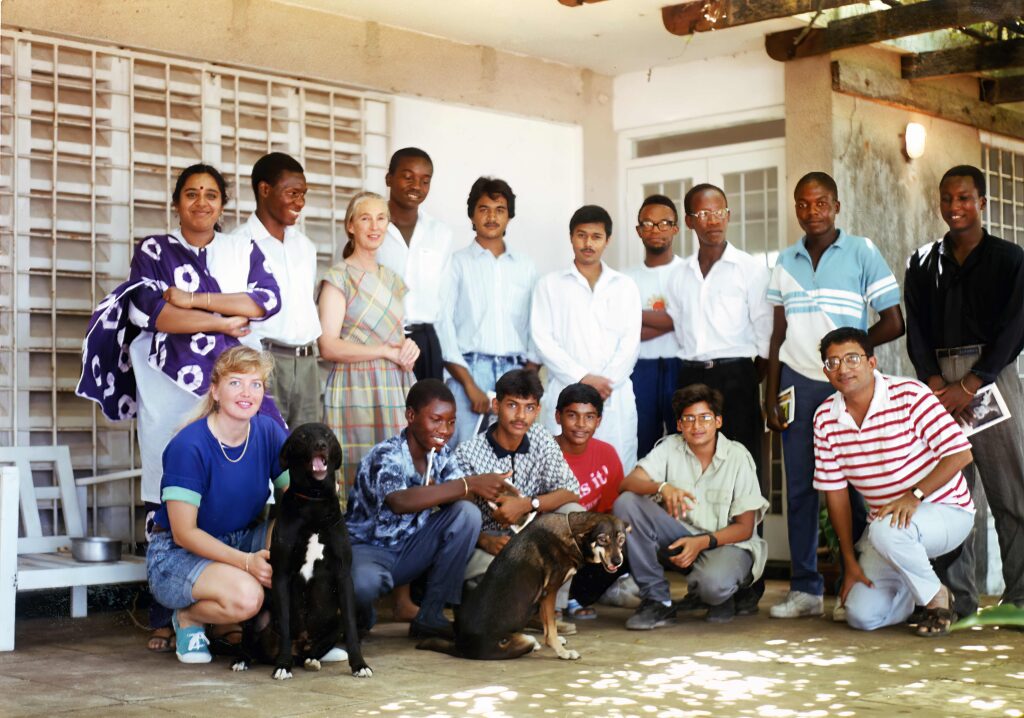
Dr. Jane Goodall, DBE, founder of the Jane Goodall Institute and UN Messenger of Peace, was a world-renowned ethologist and activist who inspired greater understanding and action on behalf of the natural world.
Jane Goodall was a global icon who spread hope and reminded us all that our daily actions make a difference, and it's up to us the kind of difference we make.
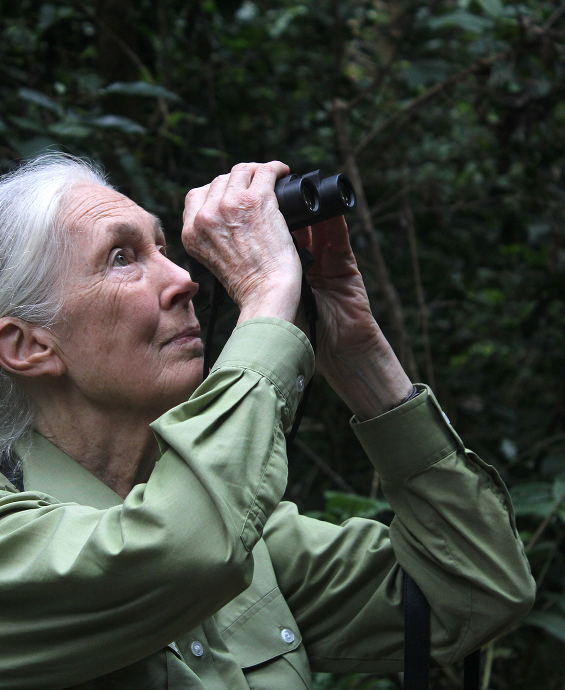
Jane is perhaps best known for her groundbreaking contributions to science through her research into the lives of wild chimpanzee communities. This study first began in 1960, when Jane was 26 years old, under the mentorship of paleoanthropologist Dr. Louis Leakey. Jane Goodall's landmark discoveries include the revelatory observation that chimpanzees make and use tools, which rocked the scientific world and forever redefined our understanding of the relationship between humans and other animals. This work continues at JGI's Gombe Stream Research Center today in what is now the longest-running wild chimpanzee study in the world.
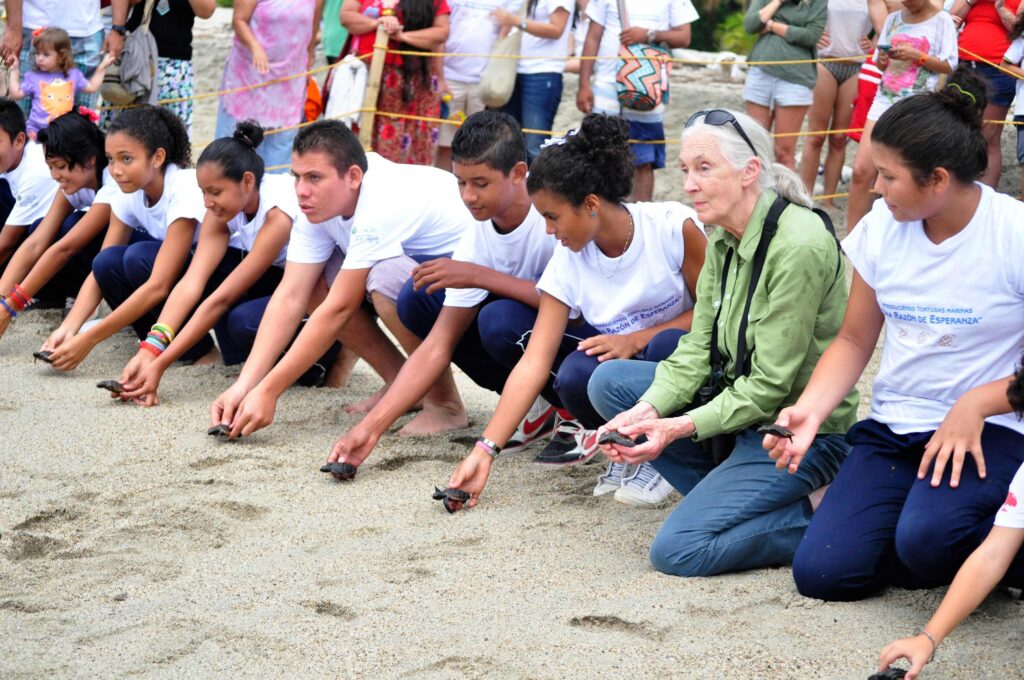
Jane founded the first Jane Goodall Institute (JGI) in the United States in 1977, and today 30 offices around the world work to support her vision of hope through action. JGI’s global work includes Tacare, which is JGI’s community-led conservation program, two sanctuaries for rescued chimpanzees and other species, the ongoing research at Gombe, and Jane Goodall’s Roots & Shoots. Roots & Shoots empowers young people of all ages in 75 countries to undertake hands-on projects of their choosing to benefit the community, animals, and the environment.
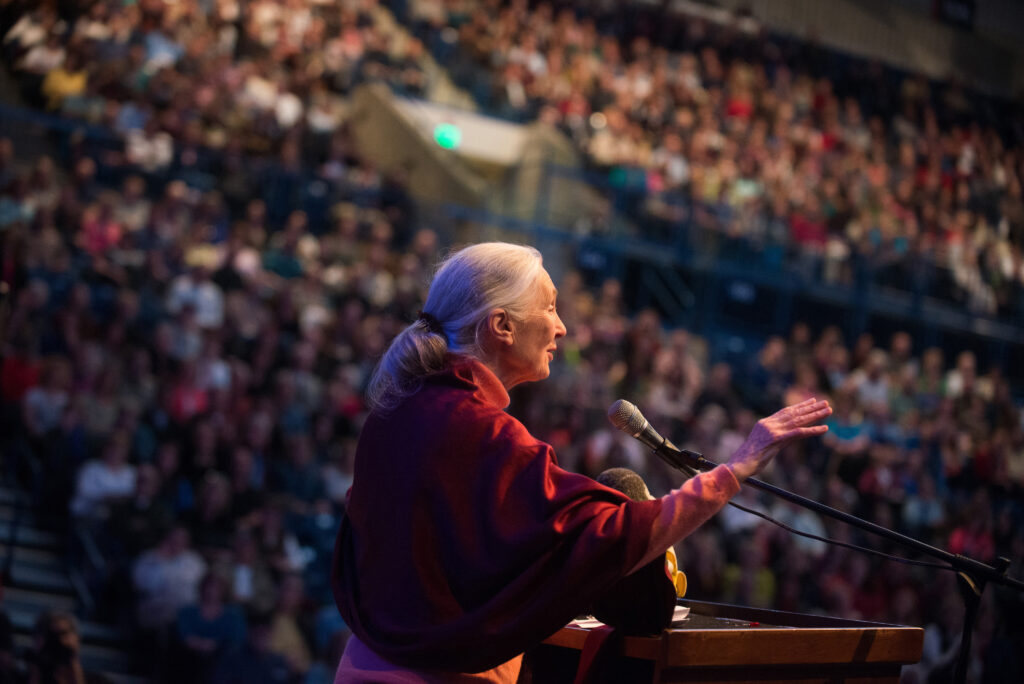
Prior to her passing at the age of 91 in October 2025, Jane traveled globally around 300 days each year, inspiring audiences through speaking tours, media engagements, written publications, and a wide array of film, television, and podcast projects. She authored many books for adults and children, including “The Book of Hope: A Survival Guide for Trying Times,” which was translated into more than 20 languages.
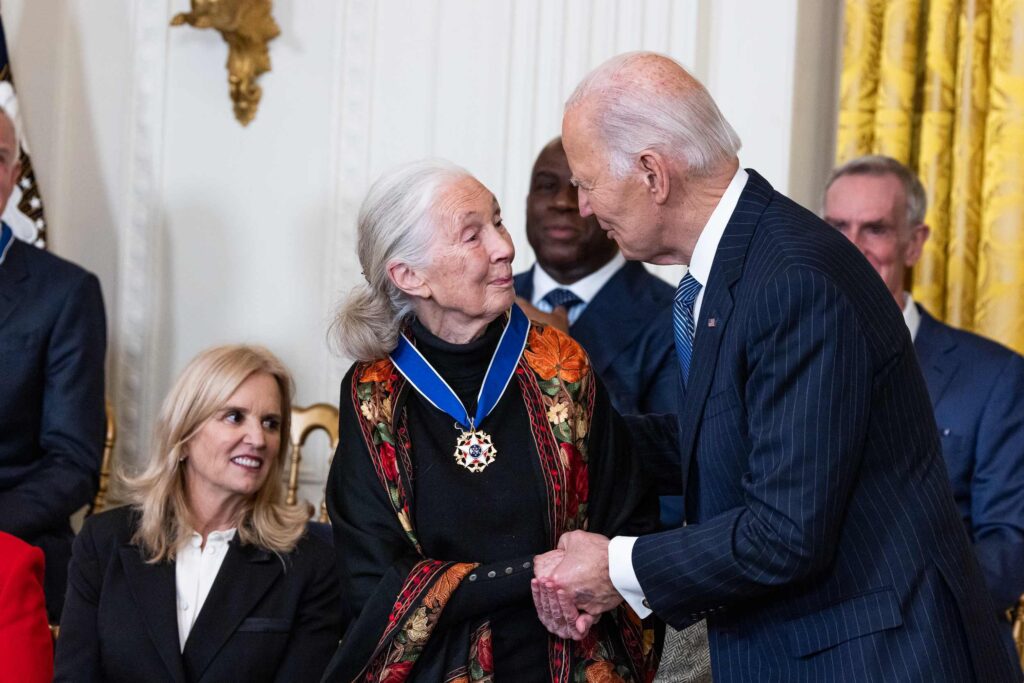
In her remarkable lifetime, Dr. Jane Goodall was named a United Nations Messenger of Peace (2002), Dame Commander of the Order of the British Empire (gazetted 2003), and received numerous global accolades including France's highest recognition, Legion d'Honneur (2006), and the United States' highest civilian honor, the Presidential Medal of Freedom (2025). Her legacy lives on in the Jane Goodall Institute and the millions of people she inspired, particularly the young people who gave her hope for the future.
Jane Goodall was born on April 3, 1934 in London, England. During World War II, Jane’s family moved to Bournemouth, England on the Southern coast of the United Kingdom, where she spent most of her childhood.
While she traveled nearly 300 days a year, Jane continued to call Bournemouth, England home, and she lived in her childhood house until her passing in 2025.
Dr. Jane Goodall held a PhD in ethology, the science of animal behavior, from the University of Cambridge. She was only the eighth person to be admitted without an undergraduate degree. She repeatedly returned to Gombe to continue her research throughout her time at Cambridge, and she earned her degree in 1966. Jane also held honorary degrees from dozens of colleges around the world.
While Jane is so well known for her wild chimpanzee research, her PhD was in ethology — or the science of animal behavior — and she did not consider herself to be a primatologist. She preferred to be described as an “ethologist and conservationist” or as a “scientist and conservationist.” Jane was curious about all animals and advocated tirelessly on their behalf.
Jane Goodall first began her landmark chimpanzee research on July 14, 1960 in what is now Gombe, Tanzania in East Africa. Her research continues to this day at JGI’s Gombe Stream Research Center, now home to the longest-running wild chimpanzee study in the world.
Jane Goodall long dreamed of living in Africa and studying wild animals. In the 1950s, she saved up enough money to go to Kenya. There, she met famed paleoanthropologist Dr. Louis Leakey, who was searching for the right person to research chimpanzees. He wanted to learn more about these (then little-known) primates and gain insight into the evolutionary past of humans. He was drawn to Jane’s patience, and her persistence to understand animals. Jane went on to discover that chimpanzees make and use tools, forever redefining the relationship between humans and the rest of the animal kingdom.
Jane took an unorthodox approach to her research, immersing herself in the chimpanzee’s habitat. After months of trying to gain their trust, she was able to experience their complex society as a neighbor, rather than a distant observer. She then further defied scientific convention by giving the chimpanzees names instead of numbers. She came to understand them not only as a species, but as individuals with personalities, complex minds, emotions, and long-term bonds. Today, thanks to Jane’s influence, many wildlife behavior studies follow suit.
Dr. Jane Goodall’s research has since been extensively validated and built upon by decades of subsequent research at Gombe Stream Research Center and beyond, which can be referenced at Jane Goodall’s Publications, Books & Media.
In the 1980s, Jane helped organize a conference in Chicago with other chimpanzee researchers, called “Understanding Chimpanzees.” While the conference was focused on research, one session on conservation opened her eyes to the threats facing wild chimpanzee populations. She would come to reflect: “I went to that conference as a scientist, and I left as an activist.”
After that conference, Jane began traveling the world to advocate for chimpanzees and their conservation. Her work soon expanded to broader animal welfare and land conservation issues. In 1991, she founded Jane Goodall’s Roots & Shoots, the youth-action program of the Jane Goodall Institute which inspires young people to make a difference for people, other animals, and the planet. In 1992, she established JGI’s Tchimpounga Chimpanzee Rehabilitation Center, which cares for chimpanzees — and today, many other species — rescued from the illegal wildlife trade. In 1994, she launched JGI’s signature community-led conservation approach, Tacare, which started in the villages surrounding Gombe National Park and has since expanded to countries across Africa.
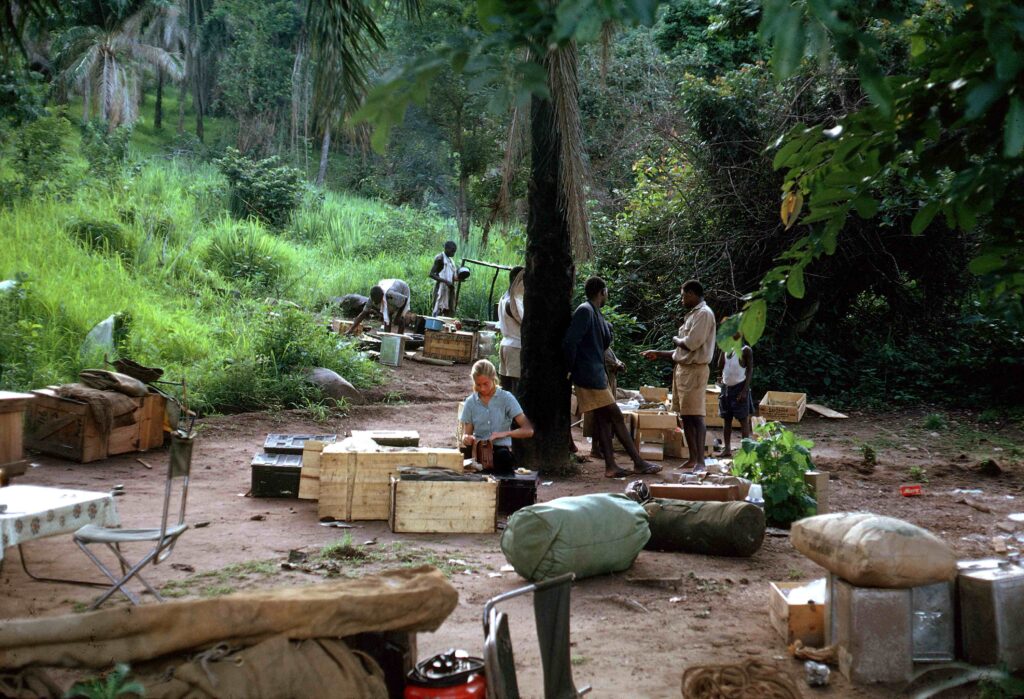
Jane’s time in Gombe taught her that everything is interconnected, and she often spoke of the natural world as a “great tapestry of life” — if you remove too many threads, the entire tapestry unravels. This philosophy informed her advocacy work, which extended from wildlife conservation and habitat preservation, to animal welfare and youth engagement initiatives. She often lent her voice to efforts to combat deforestation, biodiversity loss, climate change, and the illegal wildlife trade. Jane was a longtime vegan and was vocal about the sentience of all animals, which influenced her work on behalf of all species in the animal kingdom.
Dr. Jane Goodall’s legacy continues through the Jane Goodall Institute and the millions of people she inspired to make a positive difference. You can support her vision by donating to the Jane Goodall Institute, joining or supporting her youth-action program, Roots & Shoots, and making sustainable choices that benefit people, animals, and the environment in your daily life.
Photo credits: Katherine Holland, Shawn Sweeney, Hugo van Lawick, Masterclass, Michael Neugebauer
"We must remember that we are part of, and not apart from, the natural world, and we depend on it for clean air, water, food, clothing — everything."
- Dr. Jane Goodall, DBE