
November 6, 2026 By RSYC Fellows Virginia J. and Ayushi G.
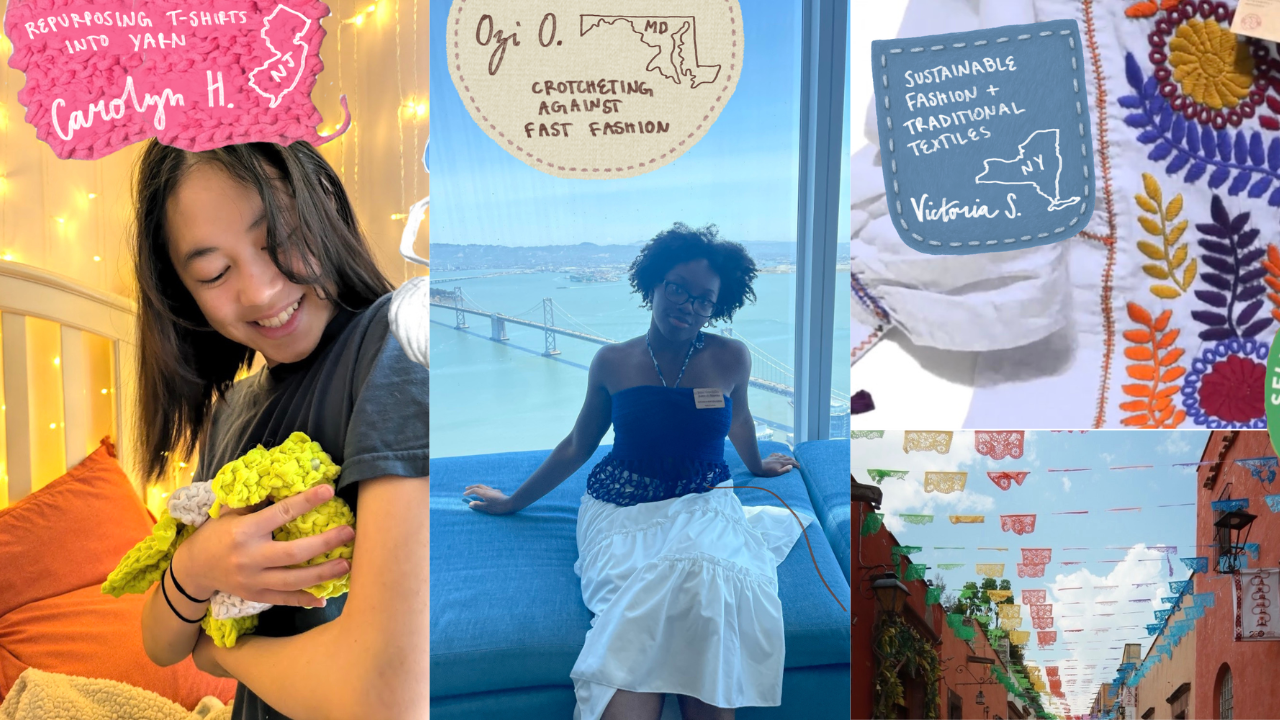
Fashion is often treated as fleeting — trends that come and go, garments worn a handful of times before being discarded. For three members of Jane Goodall’s Roots & Shoots Youth Council USA, textiles are anything but disposable. Through reclaimed yarn, crochet hooks, and traditional weaving, Carolyn, Ozi, and Victoria are reimagining fashion as a space for sustainability, creativity, and justice. Their projects confront waste, fast fashion, and exploitation head-on, proving that what we wear can carry meaning, memory, and impact.
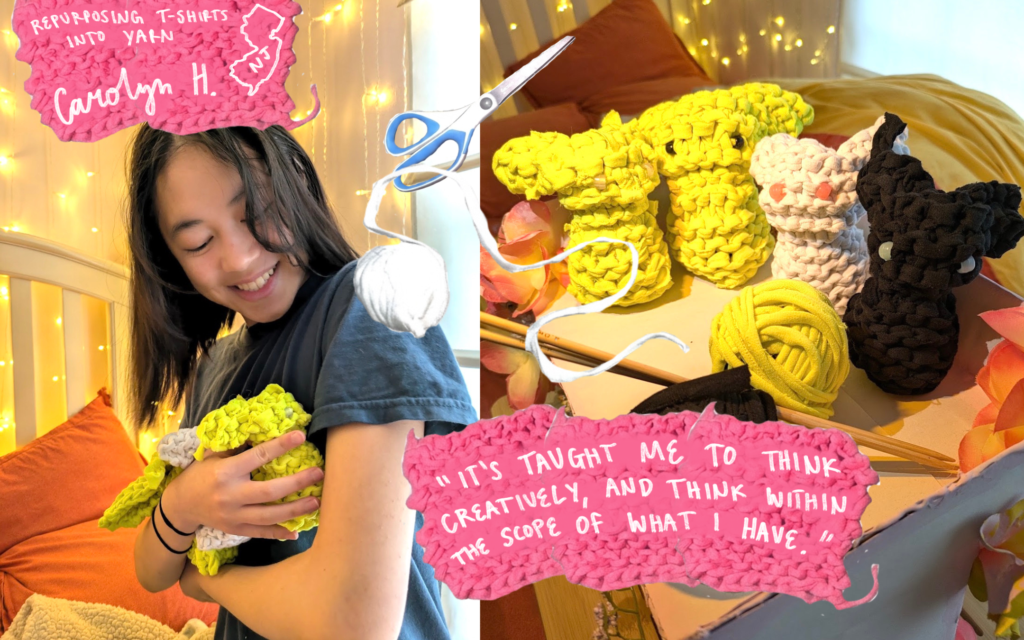
Carolyn first spotted the problem in the aisles of a thrift store. While shopping with her sister, she noticed rows and rows of T-shirts that would never be sold, destined instead for disposal due to the store’s system of rotating stock. What others saw as excess, Carolyn saw as possibility.
Together with her sister, she began reclaiming T-shirts and transforming them into “yarn.” What started with a knitted bunny design she found online quickly expanded into countless creations, fueled by donations from friends and family, and long nights spent cutting fabric into strips and winding them into skeins. “I think we often look at an object, and we have this functional fixedness in our minds,” Carolyn says. “But because of the project, I’ve been able to look at a T-shirt and see a ball of yarn, and then look at a ball of yarn and see a million different designs.”
For every knitted creature they sell, the sisters donate one to a children’s hospital. The project not only gives discarded shirts a second life, but it also brings joy to children in Carolyn’s community. The project also reshaped the sisters’ relationship to each other. Before, they would often keep to themselves, seeing each other only in passing despite living in the same house. With the project, they spent more and more time in the same room, working together, arguing, and growing closer by figuring out how to balance strengths and weaknesses, and work as a team.
Through the process, Carolyn discovered a deeper patience within herself and a renewed connection to creativity through working with her hands. The project taught her that sustainability is not just about reducing waste, but about rethinking how we value the things we already have.
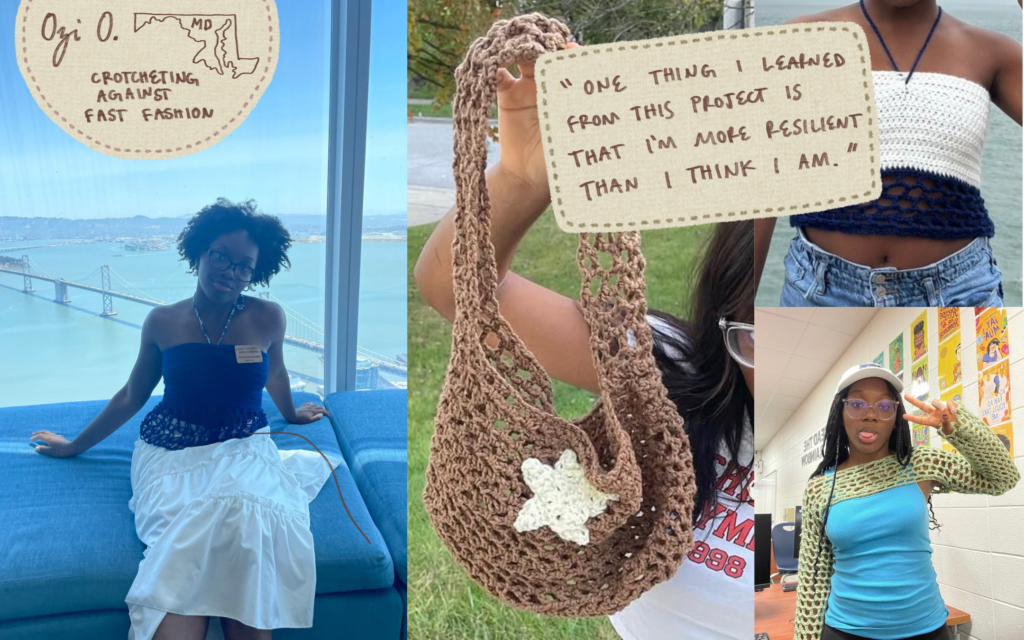
Like Carolyn, Ozi began her project by questioning the life of clothing pieces after we stop wearing them. After seeing many videos about the environmental and social costs of the fast fashion industry on social media, Ozi came to a straightforward conclusion: “I don’t want to contribute to a system that does that. I want to make my own clothes.”
To do this, Ozi has been crocheting for two years, creating pieces purely because she enjoys it. Over time, that joy evolved into purposeful action. Through Ozi Crochets, she sells some of her pieces at local markets and donates many of her creations. Ozi’s goal is not only to sell handmade clothing, but to encourage others to slow down, learn to crochet, and think critically about where their clothes come from.
It wasn’t until her first Roots & Shoots Youth Council Summit in 2025 that Ozi fully realized the impact of her work. In her community, crocheting felt normal, something many people did. But hearing feedback from other youth leaders from across the country helped her see her project through new eyes. What felt ordinary to her was inspiring to others.
Ozi is candid about the challenges of her project work. She struggles with creative block and is learning to be patient with herself. “I like to imagine creative block as a stop, but the energy is still flowing,” she says. “It’s like a plug on something, and one day the plug is going to move, and I’m going to have these great ideas.” She is also building resilience, pushing through long projects and finding motivation in the smiles of customers who connect with her work. “I’m more resilient than I think I am,” she says.
Looking ahead, Ozi hopes to pair her products with pledges that ask buyers to commit to ethical consumption, checking supply chains, avoiding child labor, and questioning fast fashion. She also wants to use crochet to explore ideas beyond fashion. One of her future projects is a tapestry inspired by the lyric, “And we are all connected to each other. In a circle, in a hoop that never ends,” from Colors of the Wind, and another explores connection through depicting the supercontinent Pangea.
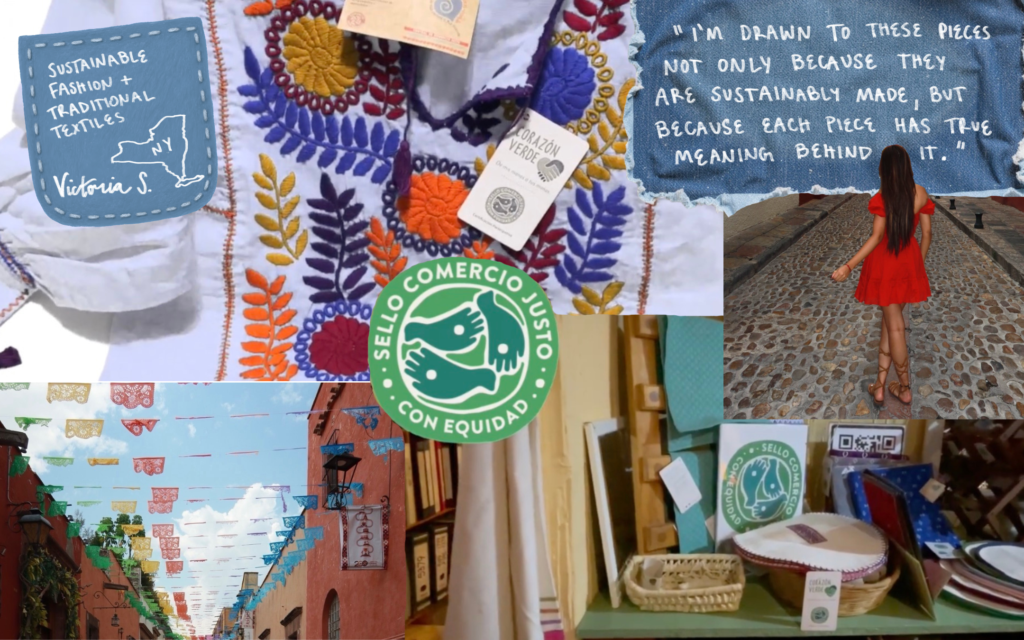
For Victoria, textiles are inseparable from identity, history, and justice. Her project, Corazón Verde (which translates to “Green Heart”), grew out of her work with a nonprofit in Mexico that supports Indigenous women through traditional textile-making. These women face what Victoria explains as “la triple discriminación,” being women, being Indigenous, and having low-to-no income
Through weaving and embroidery, the organization helps women support their families in communities where opportunities are limited and reproductive education is scarce. Each piece sold includes a tag naming the woman who made it, restoring visibility and dignity to labor that is so often erased.
Victoria’s connection to the work is deeply personal. As a proud first-generation Mexican-American with roots in Hidalgo, she sees sustainable fashion not just as an environmental issue, but as cultural preservation. When cartel violence cut off contact with the village for a time, the fragility and risk of this work became very clear. Yet reconnecting with the women reaffirmed her belief that even small efforts can create real change.
Studying history and working in asylum law has further shaped her perspective. Victoria understands that exploitative labor in the fashion industry is not a relic of the past. It is ongoing, dangerous, and often hidden behind glossy branding. “I love makeup,” she says. “I would never put something on my face if I knew it would harm me. So why would I buy clothing that I know is harming someone else?”
Today, her focus has shifted toward legal advocacy, but the values that drew her to sustainable fashion remain. For Victoria, clothing should mean something. It should reflect care — for people, for culture, and for the planet.
Carolyn, Ozi, and Victoria remind us that sustainable fashion is not one-size-fits-all. It can begin in a thrift store aisle, at a crochet market stall, or in a rural village thousands of miles away. Through reclaimed materials, handmade garments, and traditional textiles, they are challenging wasteful systems and redefining what it means to consume responsibly. Their leadership shows that when young people lead with intention and creativity, fashion becomes more than what we wear. It becomes a statement of values, connection, and care.


There is a new face at the Jane Goodall Institute’s Tchimpounga sanctuary in the Republic of the Congo,…
As we get ready to invite a 🔗 new cohort of Youth Leaders to 🔗 Jane Goodall’s Roots…
The Jane Goodall Institute is deeply saddened by the passing of our longtime friend, supporter, and leader, Donald…
