
November 19, 2026 By Kira Leinwand
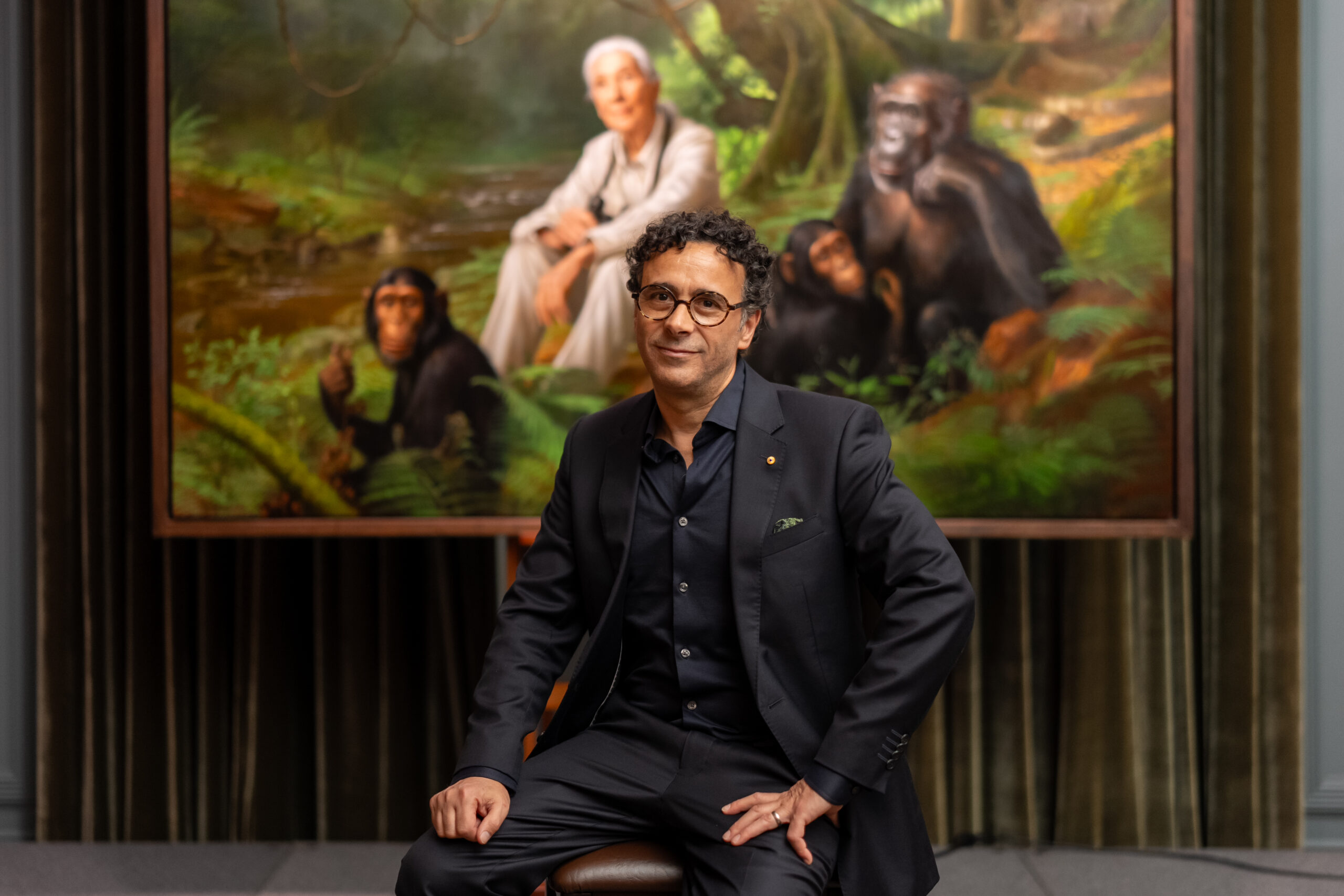
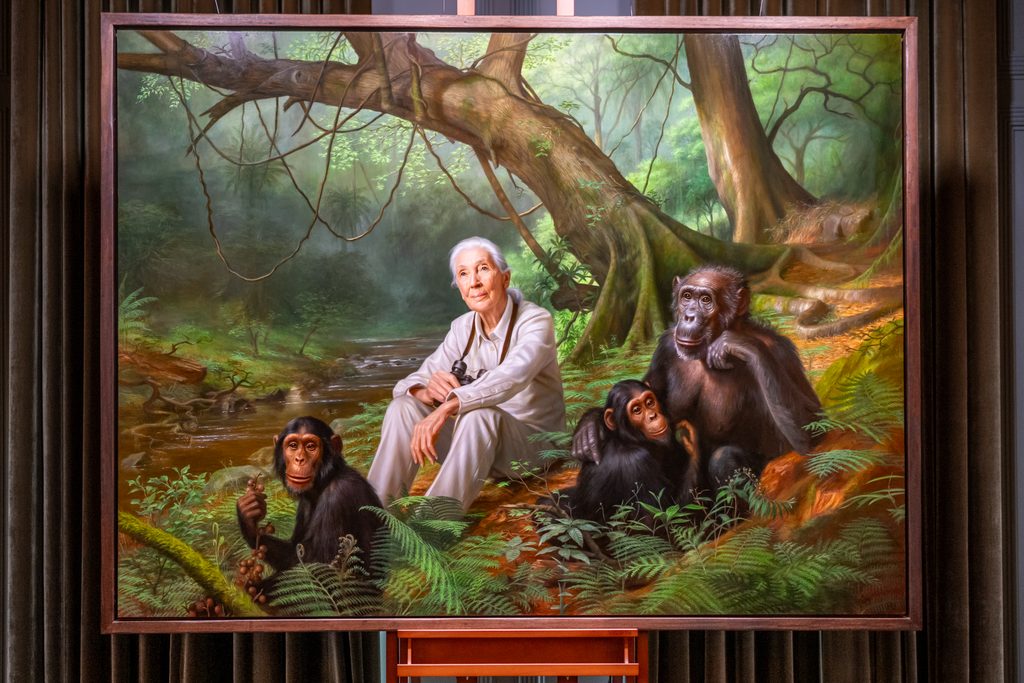
Dr. Jane Goodall’s vision lives on in so many ways: the work that the Jane Goodall Institute continues around the world, the lives of people she inspired, and numerous films, books, and works of art. Now, Dr. Jane Goodall is immortalized in an extraordinary portrait from renowned portrait artist Ralph Heimans.
This powerful tribute depicts a moment Ralph witnessed in Gombe National Park — the site of Jane’s groundbreaking chimpanzee research and the longest-running wild chimpanzee study in the world. While Jane wandered by the forests near her house, she was found by an old friend: the chimpanzee Gremlin, whom Jane had known since birth. Gremlin had not been seen for some time, but Gombe staff have repeatedly noted the uncanny punctuality with which she found her way to Jane’s camp whenever Jane was in Tanzania. This time, Gremlin brought her children, Grendel and Goodali.
Now, we know that this was one of Jane’s last encounters with Gremlin. During the portrait unveiling at Ned’s Club in Washington, D.C., we spoke to Ralph about this striking moment, and about the thought and heart that went into bringing this piece to fruition.
Kira: To start off, you’re a world-renowned portrait artist. Among your portfolio, you’ve painted royal portraits of Her Majesty Queen Elizabeth II, His royal Highness Prince Phillip, and His Majesty King Charles III. Having painted these grand figures, how did Jane compare as a subject?
Ralph: I mean obviously you couldn’t get further away from the palace than the forests of Gombe! It was amazing, and that’s why I really wanted to paint Jane, because she’s so inspiring. She’s somebody whom I always admired, and the process drew me into a world that I was unfamiliar with but wanted to learn about. It resonated with my personal passions as well. It was just remarkable meeting her and doing this portrait, and I loved being out of my comfort zone!
K: Again, very different atmosphere from the palace!
R: Very different atmosphere — you could not find a more different atmosphere! I’ve learned a lot through the process and absolutely adored it. Those moments in Gombe with Jane were some of the most incredible moments I’ve ever experienced.
K: I love the way that you said in a conversation we were having with a group earlier that you get to know the spirits of the people you paint. You talked about that not with just Jane, but with the chimpanzees you were painting as well — Gremlin, Grendel, and Goodali.
R: Yes, it was definitely a group portrait with the chimpanzees, and all the figures have equal importance. In fact, the chimpanzees are actually in the foreground, and Jane in the background.
K: That’s how she’d want it, right?
R (said simultaneously): I thought she’d like that!
K: Yeah, exactly! “The least interesting primate,” as she advised her research students to be.
R: (Laughing) That is such an interesting way to put it.
K: So speaking again about what you learned from Jane — and maybe from the chimpanzees as well — were there any particular personal lessons that you took away from this?
R: What I really admired was her philosophy of “oneness” with nature. She really had a spiritual quality about her. I feel as though after spending two, almost three years on this project, painting these works, that it’s left a part of me; I’ve been touched by Jane’s spirit — by her passions and what drove her — which became something that I came to love as well. I really do feel that it has changed me in a beautiful way.
K: In getting to know Jane’s spirit, what were some of those conversations you had with her before starting the piece?
R: We first met in Bournemouth, and so it was really wonderful to see her in her childhood home, to see how she lived very humbly. It was really good to be able to see that side of her before going to Tanzania. We talked about all sorts of things. She sat for three hours on the floor in the sitting room, talking to me, and one of the things that struck me was that she spoke about her childhood dog, Rusty, as her first teacher in animal emotions. Because I have a dog and I love my dog, I can totally relate. And we think “of course animals have emotions,” but it wasn’t known, or it wasn’t believed in those days. She had to prove it, and she did, which is the most remarkable thing.
I was also just struck by her presence. I think that’s the first thing you feel when you meet Jane, that you’re really meeting somebody who has achieved some sort of wisdom.
K: During your process, you had this remarkable moment with the chimpanzee Gremlin at Gombe. Obviously, you had no idea that that was going to happen, so I’m curious, what were your thoughts beforehand? What did you imagine this scene would be before you had that moment?
R: We were talking to Jane about it in her home in Gombe. We’d have a bit of whiskey every night, and we’d have a chat. I know that she spoke about having a spiritual experience in Gombe at one point, and I was trying to determine where that spot was. That was one thing that I was looking for, but I was looking for Gremlin — I knew Gremlin would be key to this. So, every day, that was our team’s objective: to try to find Gremlin. And we found her on the last day I was in Gombe. Not only did we have an encounter with her; she was midway down the hillside, and once she reached the foot, we saw her with Jane. It was the most incredible experience.
Finally, I knew the portrait had to be connected to Gremlin because, being the matriarch and the chimpanzee that Jane had known the longest, she would’ve had the strongest emotional connection with her. It had to do with her. That’s how I approach a portrait; I’m always looking for a story, one that says something meaningful. My gut told me that the story was connected to her and Gremlin. Luck had it that Gremlin appeared right at the foot of her home.
K: On cue!
R: On cue, thank you very much! It was amazing — all of our jaws dropped, everyone who was staying there at Gombe. We just couldn’t believe that this would happen.
K: It’s funny that you mention trying to find a story in your pieces, because that was another thing I wanted to ask about. At my job, most people I meet know and love Jane, but every now and then, I meet someone who doesn’t know her! So, if someone came up to this portrait, and they didn’t know anything about Jane at all, what is the message you’d want them to take away about who she was?
R: I’d want them to get a feel for what it’s like to be in Jane’s presence, and to get a sense of her legacy. This really came from her whole approach to her connection with the chimpanzees, which was one of almost disappearing into the forest, and just being the least interesting primate in a space. I think that is just beautifully put. I wanted to capture that sense of oneness. And it’s a unique sense of oneness; it’s not this “let’s cuddle the chimpanzees” approach, but a real respect for them, keeping that respectful distance while remaining totally integrated. It’s a visual thing, it’s a feeling! It’s sometimes really hard to articulate what Jane was able to achieve, but it’s this sense of just total integration with not only the chimpanzees, but with the forest itself!
K: That’s where art works where words fall short sometimes.
R: That’s why we have paintings.
K: This work was commissioned and donated by our longtime JGI supporter, board member, and friend of Jane, Don Kendall, who sadly passed away in September. How did he first approach you with this idea of painting the portrait of Jane, and what do you think this piece meant to him?
R: I think this piece meant everything to Don. I first met him in early 2023, when I was giving a talk at the Museum of Fine Art in Houston. He happened to be in the audience, and he came up to me afterward and said, “I happen to have been the chairman of the board of the Jane Goodall Institute.” Instantly, because Jane Goodall was always on my radar as the most amazing person to paint, I just said, “I would love to paint her.” That’s how it started, and he was the kind of guy to follow through, so he made introductions for us, and here we are three and a half years later.
It’s really remarkable. He was an extraordinarily kind, thoughtful, wonderful guide through this process. He came with us on this extraordinary adventure to Gombe with so much wisdom. It couldn’t have happened without him, and he was just wonderful at every step of the way. I really, really miss him. We really wanted him to be here — that’s why we’re here on this date, because he was able to make time then. It is lovely to have his son and his sister here.
K: Just as Don’s passing affects how we see this celebration today, how did Jane’s passing in 2025 affect your work on this painting? I think you mentioned earlier that you were only partly done with it at that point.
R: I think it really did affect my work. It’s one thing having the experience of Gombe, but it’s another thing when it’s midway through your process. It did affect the way I finished the painting; it took on a new life in a good way. The forest and the atmosphere started to get mistier and more ethereal after she passed. There was something that felt right about changing the mood from a bright, sunlit scene to a more spiritual, misty feeling. It seems more dreamlike, and it also just resonated more with me. It happened naturally. When you paint, it’s a little bit like what Jane was doing with the chimpanzees: you have to let it approach and speak to you. So I had to listen to the painting, and that’s the direction that the work took. It just felt right to represent her in a more gentle, slightly ethereal light.
K: I agree completely, and I see how that change would happen. We feel Jane’s presence so keenly in this room, but if she were here to join us today, what do you think she’d say?
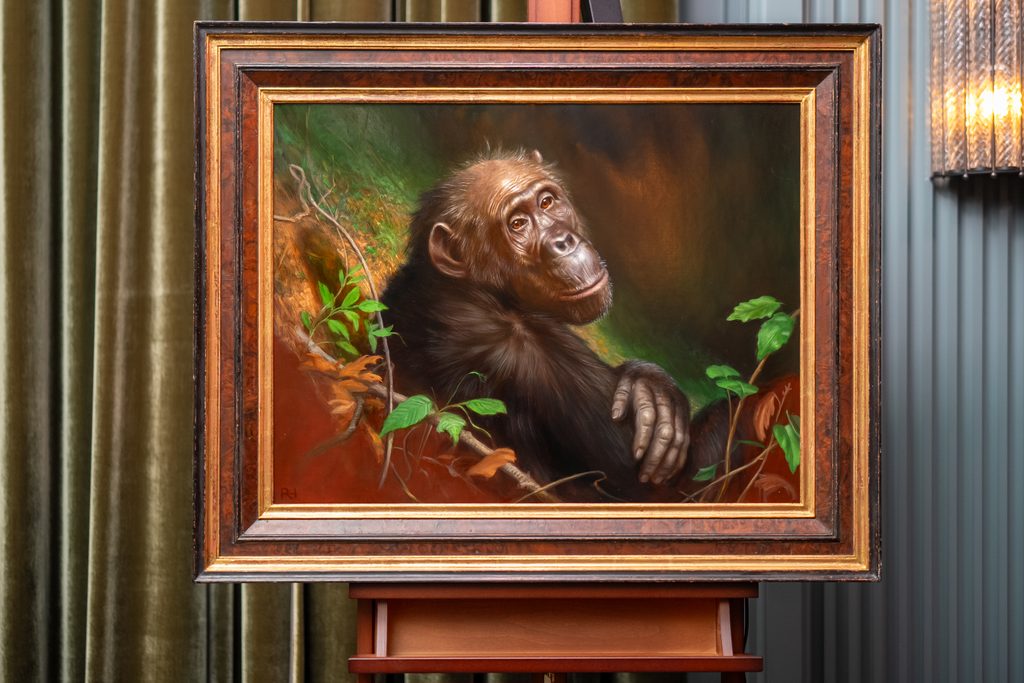
R: Well, I think she would look at the chimpanzees, and admire them hopefully, because she loved the portrait I did of just Gremlin. But, being the humble person she was, she may not have wanted to see herself so much. I’m hoping she would have been happy, because I was trying to capture not only who she was, but also her beliefs and her approach to observing and studying the chimpanzees; I tried to capture something of what she brought to her field. I hope she would have seen that.
K: I think she would have.
This work was commissioned by longtime JGI supporter, board member, and friend of Jane Don Kendall as a testament to Jane’s impact on his life and the lives of so many. We are grateful to Don for this gift by which to remember both him and Jane, and to Ralph for depicting Jane’s essence with the attention and care that she gave to all her work. Explore 🔗 janegoodall.org to learn more about how the Jane Goodall Institute is keeping Jane’s vision alive.


Fashion is often treated as fleeting — trends that come and go, garments worn a handful of times…
There is a new face at the Jane Goodall Institute’s Tchimpounga sanctuary in the Republic of the Congo,…
As we get ready to invite a 🔗 new cohort of Youth Leaders to 🔗 Jane Goodall’s Roots…
